Posts

Ownership Models Questions

1. What examples of ownership models, e.g. The Guardian’s trust ownership and The Daily Mail’s proprietor model could show the opportunities offered by the latter model for control by ‘press barons’. Ownership models like the Daily mail’s proprietor model offer a prime example of how media can be controlled to influence public political views. Press barons like Rupert Murdoch, who controls most UK tabloids, can be seen to share his political opinions in each of his newspapers; this allows for an unfair opinion to be shared with the UK. 
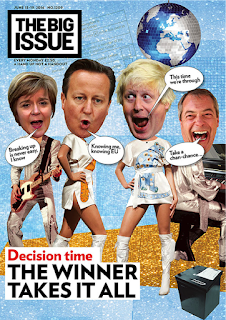
Intertextual Analysis - The Big Issue

Image
When first looking at the cover, what stands out the most is the use of humour to portray the 4 key politicians involved with the discussed topic of the issue: Brexit.   The clear intertextual link seen across the cover is with the Swedish pop group, Abba. Both the images and the text clearly relate to the band; using this link creates a humiliating and foolish portrayal of these political leaders, as the cheesiness of the band shown around them is not their typical environment. The bodies that the politicians have been placed on are members of the band, an obvious intertextual link; the bands unique style isn’t a typical outfit to be seen on these members, emphasising the humour/humiliation around the politicians. The texts, represented as speech bubbles from the politician’s mouths, are lyrics from well-known Abba songs, knowing me, knowing you and take a chance on me. They are ironic to these politicians’ beliefs around the topic; this emphasises the link to the...

Paradise papers Story coverage

Paradise papers Story coverage Daily Mail and The Guardian. When looking at how the guardian and the daily mail represent the same story, the obvious differences arise around the fact that the daily mail is a right wing tabloid newspaper and the guardian is a left wing broadsheet. Below is a list of all the conventions seen in each newspaper The Guardian: Media language: ·       Uses a Large amount of copy as it is a broadsheet and informative newspaper ·       The layout is clean and clear as it a much more expensive paper and doesn’t need to make room for splash story headlines and ads ·       The use of yellow compliments the guardians traditional blue, creating an eye catching effect for readers. ·       The use of a logo for the paradise papers can emphasise the importance of the topic and can make it easily recognisable for when they comment on the stor...

Ownership and Regulation

Ownerships of national newspapers: ·       The Guardian, The Observer – Scott Trust Limited ·       ­The Daily Telegraph – Barclays Brothers Press Holdings ·       The Daily Mail, The Mail On Sunday – Lord Rothermeres Daily Mail And General Trust Plc. ·       The Sun, the Sun on Sunday, The Sunday Times, The Times – News Corporation Chairman And CEO, Rupert Murdoch ·       The Sunday Express, The daily express, The Daily Star   – Richard Desmond’s Northern And Shell As seen above, many companies own more than one national newspaper. Links can be seen in the titles of newspapers held under the same company. For example, most newspapers have a Sunday equivalent, still held under the same company. Scott trust LTD owns the guardian ad the observer, newspapers that are both centre left wing newspapers; this can show a link between the titles...

The Big Issue - Background info

The launched in 19991 in response   to the growing number of homeless people in London. They offer people the opportunity to earn income through selling the magazine to the public. Their aim is dismantle poverty through creating opportunity. The Big Issue  tends to use a more minimalistic approach, especially in relation to their front cover designs. Unlike well known newspapers, the big issue doesn’t feature a large amount of text on their front covers, this allows them to use more image and colour to stand out easily. The Big Issue's target audience is a younger audience. The Big Issue covers a range of topics, from celebrities and current world issues to finance and culture. They present their topics in more informative and stylistic way than gossip, which can attract a more middle class audience. 72% of Big Issue readers are ABC1. 43% of readers are AB (Stats taken from The Big Issue website).